Client projectAILive
LawBot Africa
AI legal platform for African jurisdictions: an assistant that answers in plain language, a contract generator, and a document analyser, in one workspace.
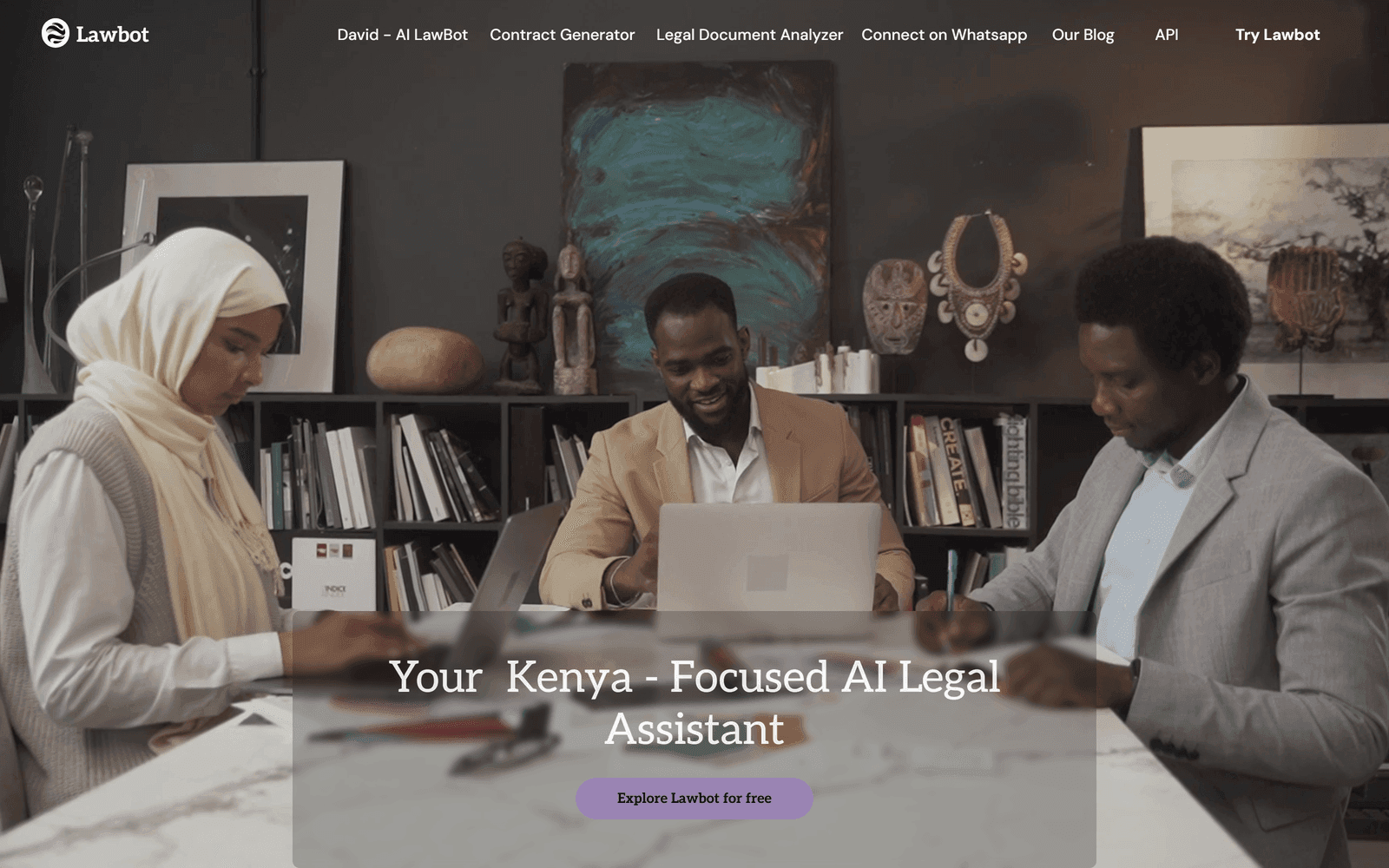
Result
Ask, draft, and review in one workspace
The problem
Legal help is priced by the hour, so routine legal work stays undone. A trader needs a supply agreement, a landlord needs a tenancy clause checked, an NGO needs to know what a statute actually requires, and none of those questions are worth a retainer. What follows is unsigned agreements and contracts nobody has read.
What I built
Built the platform around the three jobs people actually arrive with rather than a single chat box: ask a legal question, draft a contract, or check a document that already exists. Each is its own surface over the same jurisdiction-scoped corpus, so an answer, a draft, and a review all reason over the same body of law. The assistant is presented per market rather than as one pan-African model, because the jurisdiction is what makes the answer usable.
The outcome
A live product with a free tier through to team accounts, reachable on the web, over WhatsApp, and through an API, answering in local languages rather than only in English.
How it works
- 01
David, the assistant, answers legal questions in conversation, scoped to one jurisdiction at a time rather than to law in general.
- 02
The contract generator turns a described arrangement into a draft the user edits in place, instead of a blank page.
- 03
The analyser reads a contract the user already has and reports what it says and where the risk sits.
- 04
Workspaces and document storage keep matters separate, so a team can work in one account without mixing files.
- 05
WhatsApp is a first-class entry point, because that is where the question gets asked first, and an API exists for teams that want the capability inside their own product.
The AI layer
Generation is grounded in a jurisdiction-scoped corpus rather than in the model's own recall, because a confident citation to a statute that does not exist is the failure mode that matters in legal work. Multilingual interaction covers Luganda, Kiswahili, Runyakitara, Kinyarwanda, French, Hausa, Yoruba, Igbo, and Arabic, so the language of the question does not have to be English.
The engineering layer
The parts that must not be probabilistic are not: document storage, workspace membership, plan limits, and usage accounting are ordinary application code. Plans are metered by word volume, which means usage has to be counted exactly on every request rather than estimated.
Key technical decisions
One jurisdiction at a time, done properly.
Scoping to a single legal system is the reason the answers are worth anything. A pan-African assistant would have to hedge every response across dozens of them, and a hedged answer is not usable advice. The site names the jurisdiction it is answering for, which is the honest way to present it.
WhatsApp is not a notification channel here.
In this market it is the default interface. Treating it as an entry point rather than an afterthought is what makes the product reachable by the people who need it most.
Three surfaces, not one chat box.
Asking, drafting, and reviewing have different inputs and different output shapes. Collapsing them into one conversation makes all three worse.